

| First held: | 1959 |
| Times held: | 66 |
| Circuit: | Daytona International Speedway |
| Circuit length: | 4 km (2.5 miles) |
| Distance: | 500 miles / 200 laps |
| Most wins (driver): | 7x Richard Petty (1964, 1966, 1971, 1973, 1974, 1979, 1981) |
| Most wins (team): | 9x Petty Enterprises |
| 9x Hendrick Motorsports | |
| Most wins (manufacturer): | 26x Chevrolet |
The Daytona 500 is an annual showpiece race of the NASCAR Cup Series and was first held in 1959. It has also been the opening round of the Cup Series season since 1983.
NASCAR replaced Riverside with the Daytona International Speedway as the opening race of its campaign. That year’s race also marked the 25th running of the Daytona 500, which Cale Yarborough won with a Pontiac Le Mans that had been a static display outside a restaurant.
Bill France, the founder of NASCAR, also conceived the creation of the Daytona International Speedway from 1957-59 for $2.5m ($28m/£21.5m today) to give motorsport a true home in Florida’s Fun Coast region. Races had been held in the area since 1903, but without a venue.
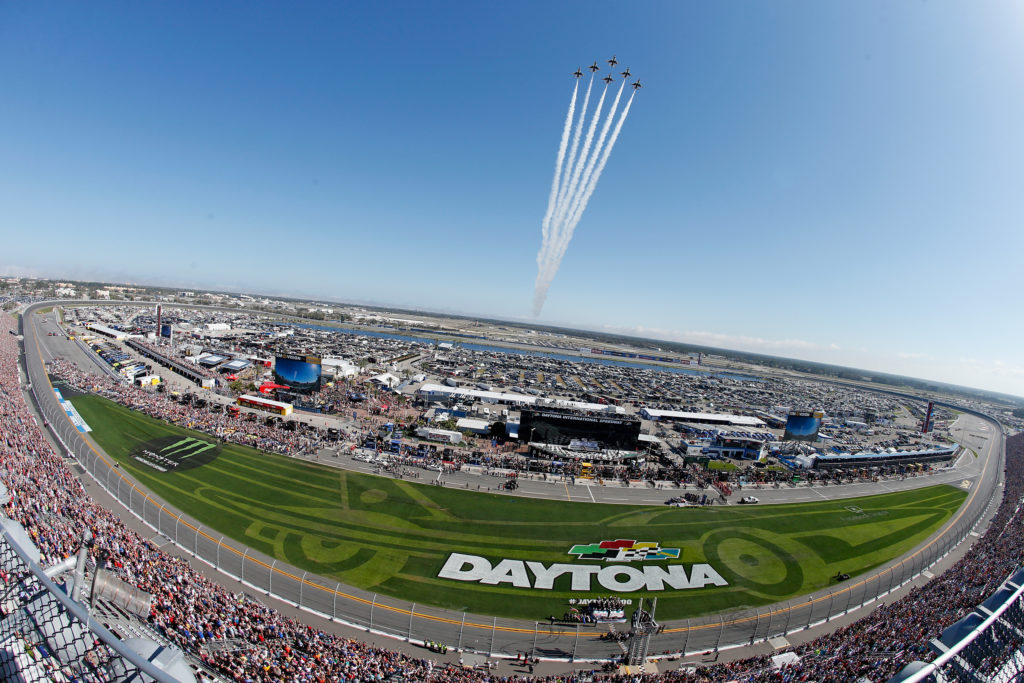
History of the Daytona 500
The maiden running of the Daytona 500 on February 2, 1959 even marked the first race held at the Daytona International Speedway. More than 41,000 fans flocked to Florida to catch 59 cars fight for a $70,000 ($784k/£598k today) prize purse, yet left without knowing who won.
It took NASCAR three days to rule that Richard Petty won the inaugural Daytona 500 in front of Johnny Beauchamp as the finish was so tight. Technological advancements over the years have avoided a repeat but the Daytona 500 often delivers photo-finishes with the pack tight.
The Daytona 500 also continues to put up the largest prize purse in the NASCAR Cup Series calendar to further its status as the blue riband race on the schedule. It is also known as the Super Bowl of stock car racing and draws millions of TV viewers plus over 100,000 in person.
Back in 1979, the Daytona 500 also became the first 500-mile NASCAR race to be broadcast live on national TV in America. Yet the honour of being the first 500-mile NASCAR race went the way of the Southern 500 at Darlington Raceway in South Carolina in the 1950 campaign.
One of the names most widely allied with the Daytona 500 is also only a one-time winner in Dale Earnhardt Sr. He became synonymous with the race after debuting in the 1979 edition, and the North Carolina native finally took his only Daytona 500 victory at the 1998 meeting.
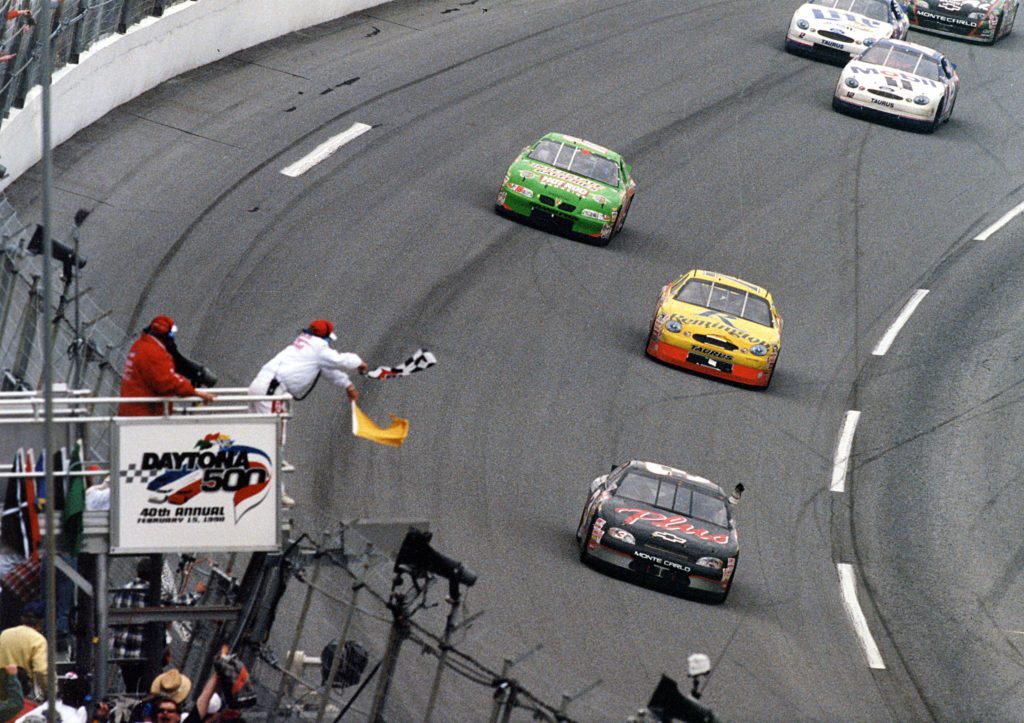
His “20 years of trying, 20 years of frustration” was finally over after Earnhardt largely faced reliability issues and crashes at the Daytona 500 up until the 1998 meet. The 2001 Daytona 500 is also known as Black Sunday in NASCAR circles as Earnhardt Sr died on the final lap.
Seven-time NASCAR champion Earnhardt Sr crashed into the outside wall after contact with Sterling Marlin while fighting over third place as Michael Waltrip and Dale Earnhardt Jr vied for the Daytona 500 win in 2001. Waltrip would win the race whilst driving for Earnhardt Sr.
Rain would even overshadow Waltrip’s second win at a Daytona 500 in 2003, which marked the shortest-ever running of the race. Race organisers declared a result after 109 of the 200 organised laps with further rain on the forecast following several stoppages and long delays.
Earnhardt Jr later picked up his first Daytona 500 win in 2004, while Ryan Newman won the 50th running in 2008. The 2013 edition further saw Danica Patrick become the first woman to take pole position for a Daytona 500 and the first woman to lead a lap under green flags.
Changes to the Daytona 500 in 2017 even saw NASCAR introduce mandatory stage cautions to help improve its show at races which offered few championship points. The manipulated stoppages standardised race strategy in an attempt to retain the attention of the audiences.
What does it take to win the Daytona 500?
On paper, a driver only has to get the nose of the car over the finish line first at the Daytona International Speedway for NASCAR to crown them the winner of a Daytona 500. But that is not all a driver needs to win the blue riband event, split into two 65 and one 75 lap sections.
Luck also plays a huge part in winning the Daytona 500 given the sheer number of crashes in a NASCAR Cup Series race. Mastering the art of drafting also has a big role in determining the outcome of the event, with the 31-degree banking creating many long on-throttle spells.
Drafting also limits the importance of tyre management and fuel saving at the Daytona 500, where drivers and teams place greater importance on maintaining a good position amongst the leading pack. Pitting for tyres or fuel out of sequence can move drivers out of the battle.
The winner of the Daytona 500 receives the Harley J Earl Trophy
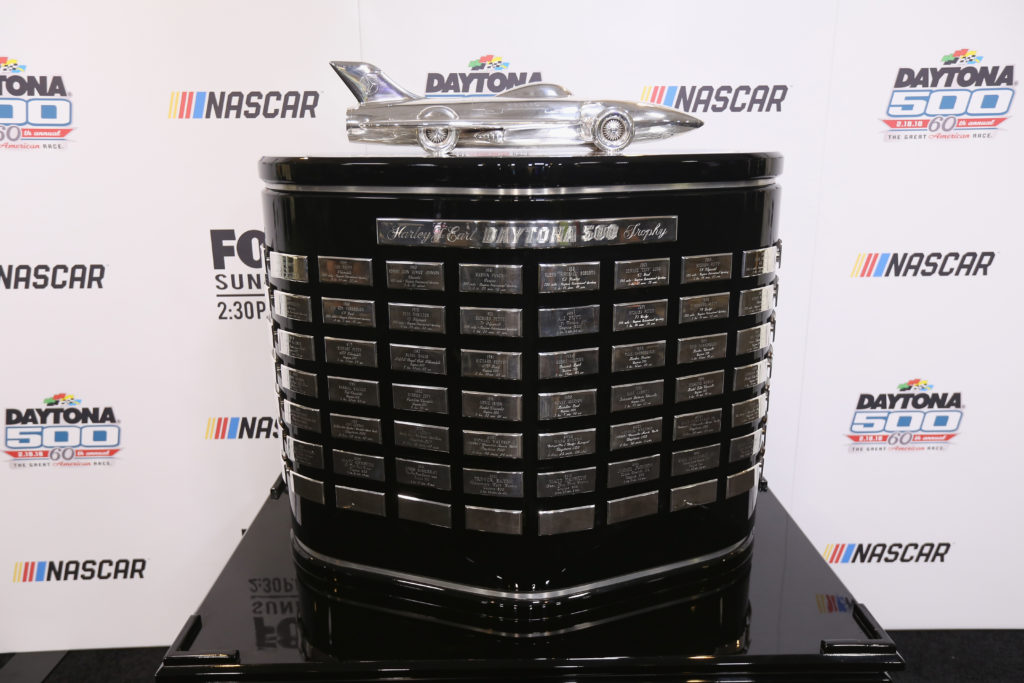
NASCAR gives the driver who wins a Daytona 500 the Harley J Earl Trophy, which they do not get to keep. Instead, the winning driver receives a miniature replica of the actual Harley J Earl Trophy, with the real version always on display at the Daytona International Speedway.
The Harley J Earl Trophy is named after famous automobile designer Harley Earl, who is best known for his time at General Motors. Earl was the head of design at GM and later became the vice president. It was also the Californian behind the creation of the Chevrolet Corvette.
Earl further acted as the second commissioner of NASCAR, which even included a model of the GM Firebird he designed on the Harley J Earl Trophy given to Daytona 500 winners. The trophy first awarded in 1959 measures in at 120cm tall (3 ft 11) and is 150cm (4 ft 11) wide.
NASCAR further designed the body of the trophy, which features plaques with the names of every Daytona 500 winner yet, after the tri-oval Daytona International Speedway track. The winning driver gets a replica trophy that is 46cm tall (18 inches) and 56 cm (22 inches) wide.
Petty Enterprises and Hendrick Motorsports are the most successful teams at the Daytona 500
William Byron won the 2024 running of the Daytona 500 under caution to also see Hendrick Motorsports match Petty Enterprises’ record tally as the most successful team in the history of the race. Petty Enterprises were alone atop the table with seven wins from 1959 to 1981.
Lee Petty, the founder of Petty Enterprises, also took the team’s first Daytona 500 win at the debut edition of the race in 1959. It even then proved to be a family affair as his son Richard Petty got seven Daytona 500 wins. Pete Hamilton is the sole non-Petty to win with the team.
Hendrick Motorsports had to wait a little bit longer to win a Daytona 500, with Geoff Bodine sealing the first of their record tally in 1986 on the team’s third visit. Jeff Gordon and Jimmie Johnson also tasted Daytona 500 success with wins whilst driving for Hendrick Motorsports.
List of every Petty Enterprises win at the Daytona 500:
| YEAR | TEAM | DRIVER | MANUFACTURER | WINNING MARGIN |
| 1959 | Petty Enterprises | Lee Petty | Oldsmobile | Less than a yard |
| 1964 | Petty Enterprises | Richard Petty | Plymouth | One lap |
| 1966 | Petty Enterprises | Richard Petty | Plymouth | One lap |
| 1970 | Petty Enterprises | Pete Hamilton | Plymouth | Three car lengths |
| 1971 | Petty Enterprises | Richard Petty | Plymouth | 10 seconds |
| 1973 | Petty Enterprises | Richard Petty | Dodge | Two laps |
| 1974 | Petty Enterprises | Richard Petty | Dodge | 47 seconds |
| 1979 | Petty Enterprises | Richard Petty | Oldsmobile | One car length |
| 1981 | Petty Enterprises | Richard Petty | Buick | 3.5 seconds |
List of every Hendrick Motorsports win at the Daytona 500:
| YEAR | TEAM | DRIVER | MANUFACTURER | WINNING MARGIN |
| 1986 | Hendrick Motorsports | Geoff Bodine | Chevrolet | 11 seconds |
| 1989 | Hendrick Motorsports | Darrell Waltrip | Chevrolet | 7.2 seconds |
| 1997 | Hendrick Motorsports | Jeff Gordon | Chevrolet | Under caution |
| 1999 | Hendrick Motorsports | Jeff Gordon | Chevrolet | 0.128 secs |
| 2005 | Hendrick Motorsports | Jeff Gordon | Chevrolet | 0.158 seconds |
| 2006 | Hendrick Motorsports | Jimmie Johnson | Chevrolet | Under caution |
| 2013 | Hendrick Motorsports | Jimmie Johnson | Chevrolet | 0.129 seconds |
| 2014 | Hendrick Motorsports | Dale Earnhardt Jr | Chevrolet | Under caution |
| 2024 | Hendrick Motorsports | William Byron | Chevrolet | Under caution |
Richard Petty won the Daytona 500 a record seven times
No driver has ever won the Daytona 500 more often throughout the history of the race than NASCAR legend Richard Petty, who sealed a record seven wins between 1964 and 1981. He first entered a Daytona 500 in 1959 and continued to enter the blue riband event until 1992.
Petty even only entered the Daytona 500 for a team other than that founded by his dad, Lee Petty, twice. He contested the race in 1984 and 1985 driving a Pontiac for Curb Racing, but it was not a fruitful partnership with Petty ending those Daytona 500s in 31st and 34th places.
His wins in 1973 and 1974 with Petty Enterprises even made Richard Petty the first driver to win consecutive Daytona 500s. Yet the 1961 running was not a happy memory for the Petty family as Lee and Richard went over the guardrails during separate accidents that weekend.
List of every Daytona 500 win by Richard Petty:
| YEAR | TEAM | MANUFACTURER | WINNING MARGIN |
| 1964 | Petty Enterprises | Plymouth | One lap |
| 1966 | Petty Enterprises | Plymouth | One lap |
| 1971 | Petty Enterprises | Plymouth | 10 seconds |
| 1973 | Petty Enterprises | Dodge | Two laps |
| 1974 | Petty Enterprises | Dodge | 47 seconds |
| 1979 | Petty Enterprises | Oldsmobile | One car length |
| 1981 | Petty Enterprises | Buick | 3.5 seconds |
What is the Daytona International Speedway oval course like?

The NASCAR Cup Series visits the Daytona International Speedway multiple times each year, with the Daytona 500 kicking off every season followed by a 400-mile race later in the term – currently called the Coke Zero Sugar 400. The track holds both races on its tri-oval layout.
Daytona has multiple circuit configurations, including a road course for NASCAR since 2020 which adopts most of the sports car circuit first introduced in 1985. The Daytona 500 is only ever run on the tri-oval course, which measures in 2.5 miles long and has four official turns.
The start/finish line for the Daytona 500 is called the Front Stretch thanks to a small straight segment which completes the triangular layout beside pit road. Turns 1-2 and 3-4 also boast 31 degrees of banking, compared to the back straight which offers three degrees of banking.
How to buy tickets for the Daytona 500
The Daytona International Speedway offers several options for all fans looking to buy tickets for the Daytona 500. Tickets to attend the flagship race of the NASCAR Cup Series calendar include fan zone admission, reserved grandstand seats and hospitality for the Daytona 500.
Fans can also buy multi-day Daytona 500 tickets, which deliver reserved seating for the main race and the qualifying races. Daytona 500 hospitality packages also offer unrivalled views and/or lounge entry. Full ticket details are on the Daytona International Speedway’s website.